Twenty years building AI products at Google and Meta. Now solo, building Kneaded.ai for small businesses, CCC for parallel agents, and notes on what works in between.
I left Meta a year ago because I'd lost track of being close to the work. Most of what I write here is what I've learned since: building software for a single customer, running dozens of Claude Code sessions in parallel, and the UX patterns that turn AI output into something a real person can trust.
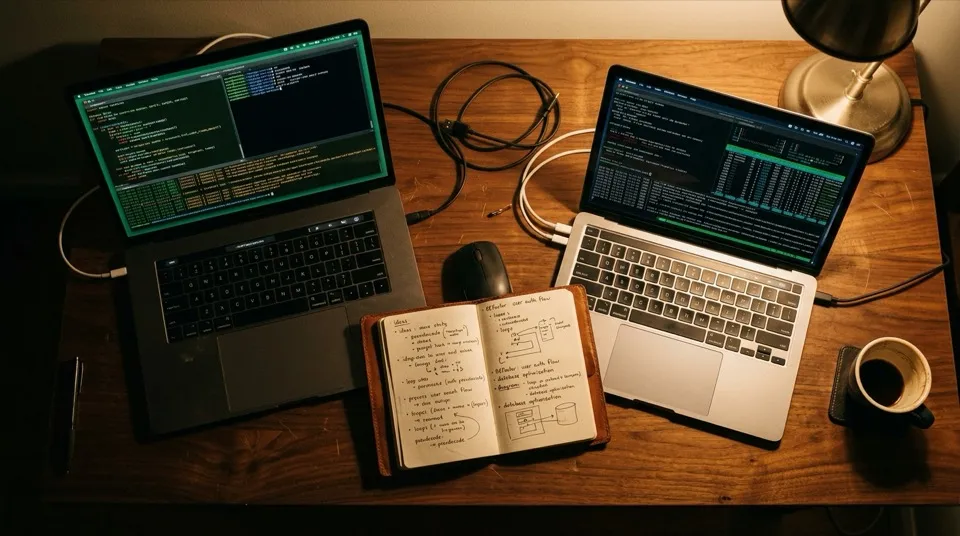
The day-to-day. Two Claude Code sessions, a notebook between them.
Index
Eight field notes, in order of recency.
Short essays on AI product work, written for builders, not buyers. Each one tries to leave you with one operational idea you didn't have when you started reading.
The 11-slide field deck, with its companion video. Real receipts first — $160K+ processed, ~5,000 appointments — then the operating system behind them: agent roles with owners, a shared group chat, a "full-time" tech-lead agent, decision gates, and every break becoming a test. All of it built on CCC, all of it open-source.
If you're a PM who can't read code, AI just made you more replaceable, not 10x more powerful. The friction was never engineers; it was time and handoff. A real architecture call from this week, the two-week version of the same decision, and five things to do this week if you want to close the gap.
Notes from a workshop with seven NVIDIA PMs. Code stopped being the bottleneck, and what's left is the harder problem product orgs weren't trained to solve at scale. The shape of an AI-native product operating system1: six plain-text files, two composable layers, codification plus multiplication.
A markdown commit-coordination protocol and a local search index over every transcript on the machine. Both built around CCC2. The wins aren't smarter prompts. They're better record-keeping. The kanban becomes a directory; the chat becomes a pipe.
Why human in the loop3 is usually rubber-stamping, and the UX pattern that actually works. Three versions of an expense tracker taught me more about AI product design than a year at Google. The third version is the one every team should be building from the start.
AI just made bespoke software cheap enough to ship for a single customer. The one-size-fits-all SaaS era is quietly ending. The studios and bakeries and plumbers that figure that out first are going to leave generic software behind. The build cost is now an order of magnitude lower than the SaaS it replaces.
Three weekends of work replaced Acuity, Square, an SMS service, and a Sunday-night spreadsheet. Venmo payments at zero processing fees. Pays-through4 reconciliation no commercial scheduler will ever ship. Admin time: four hours a week, then twenty minutes. The proof case for everything I'm building now.
How I build software now: Claude Code writing the application logic on one terminal, Claude in a browser configuring the third-party APIs on another. Two simultaneous threads of work I'm orchestrating, not executing. The setup that scaled to thirty parallel sessions before CCC had to step in.
Advisory · Workshops · 1:1
Talk to me about embedding AI in your product work.
I take a handful of engagements at a time: early-stage AI startups, product orgs scaling AI work, and product teams trying to embed AI deeper into how they actually ship. The bar isn't an impressive demo; it's a clear spec for the right thing. Four flavors:
Workshop. Half-day or full-day session for a product team, on embedding AI into how the team writes specs, runs reviews, and ships features. Recent example: a session with seven NVIDIA PMs · see the deck.
1:1 strategy session. A single 60-minute consultation. $200, focused on your product spec or a specific decision you're stuck on.
Fractional retainer. Embedded alongside a small product team: monthly cadence, into specific initiatives.
Product-leader engagement. A weekly thinking-partner cadence with a VP / CPO / founding PM. Deeper context, longer arc.
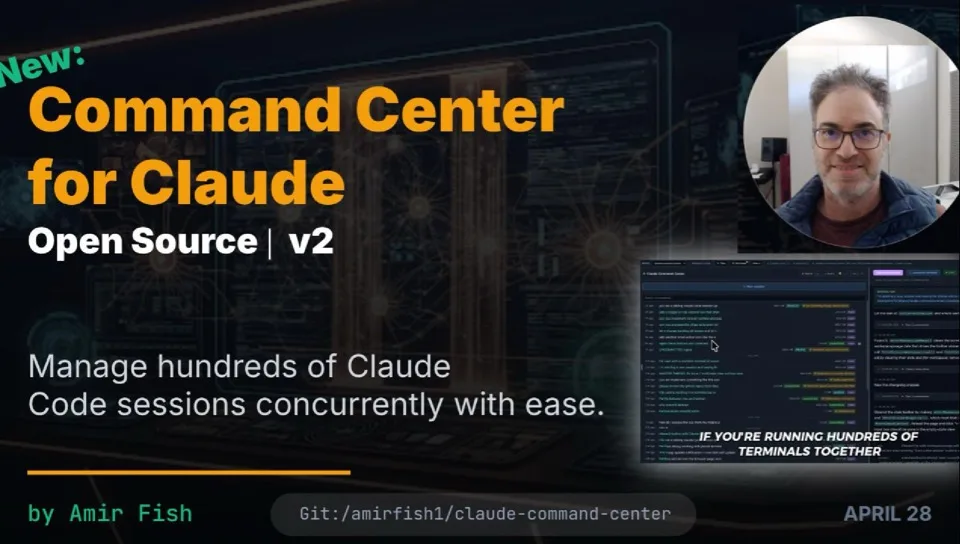
The kanban that took me from "two terminals" to thirty parallel Claude Code sessions without losing track of any of them. Local, private, no daemon. Two of the field notes above came directly out of building it. Two-line install on macOS:
InstallmacOS · zsh
git clone https://github.com/amirfish1/claude-command-center
cd claude-command-center && ./run.sh